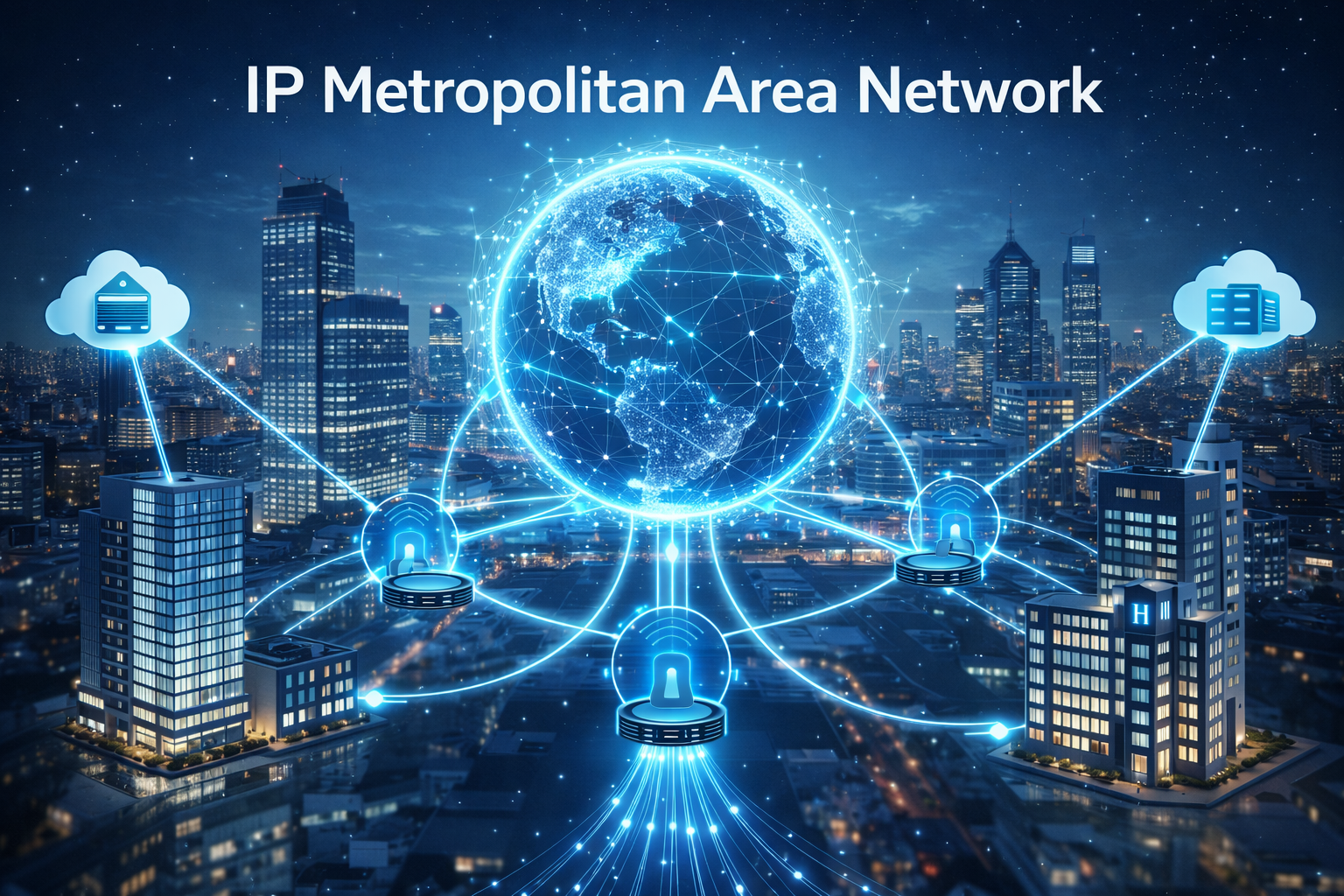
We’re all used to the Wi-Fi in our offices (the LAN) and the vast expanse of the internet (the WAN). But in 2026, there’s a massive middle layer that actually does the heavy lifting for our cities. It’s called the IP Metropolitan Area Network (MAN).
Think of it as the digital circulatory system of a city. If you’ve ever wondered how a hospital on one side of town can pull a high-res MRI from a clinic on the other side in seconds, or how smart traffic lights stay synced across fifty intersections, you’re looking at an IP MAN in action.
What’s the “IP” Part All About?
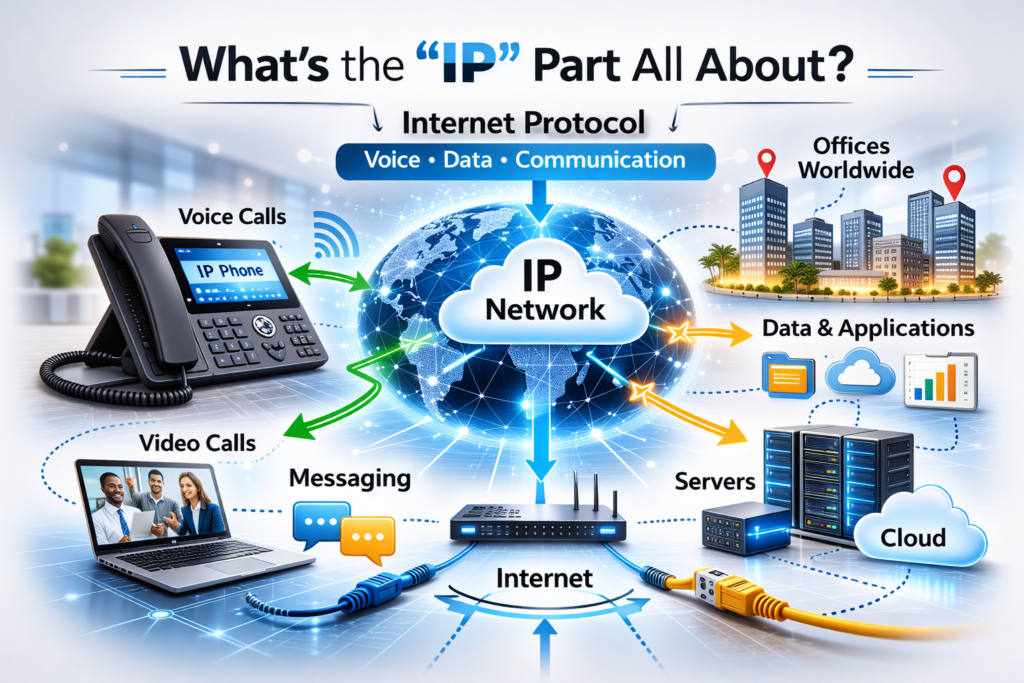
The “IP” stands for Internet Protocol. It’s the common language that allows different systems—like a university’s research lab and a government data center—to talk to each other without a translator. By using IP, these networks can move massive amounts of data across a 50-kilometer radius with the same speed you’d expect from a computer plugged directly into your office wall.
Why Cities are Doubling Down on MANs in 2026
1. The “Smart City” Reality
We’ve moved past the “Smart City” hype into actual implementation. IP MANs are now the backbone for everything from air quality sensors to real-time public transit tracking. You can’t run a modern city on fragmented connections; you need a unified fiber backbone that covers the entire zip code.
2. The Hybrid Work Engine
With teams split between downtown headquarters and suburban co-working spaces, the IP MAN acts as the bridge. It allows a company to treat three different buildings across the city as one single office. You get the security of a private network with the speed of a local connection.
3. Healthcare and Instant Data
In 2026, healthcare is all about speed. Telemedicine isn’t just a video call anymore; it’s the real-time sharing of massive diagnostic files. An IP MAN ensures that a specialist can assist in a surgery remotely because there’s virtually zero “lag” between the two locations.
The Pros and Cons: A Reality Check
The Upside
-
Insane Speed: We’re talking about fiber-optic speeds that make traditional internet connections look like dial-up.
-
Cost Management: It’s actually cheaper for a city or a large corporation to run one unified MAN than to pay for dozens of separate, high-speed WAN links.
-
Resilience: Most modern MANs are “self-healing.” If a cable gets cut during roadwork, the network automatically reroutes the data through a different path in milliseconds.
The Downside
-
High Entry Cost: Digging up roads to lay fiber isn’t cheap. It’s a massive upfront investment that usually requires a mix of private and public funding.
-
Security Complexity: When you connect an entire city, you create a larger “attack surface” for hackers. This is why platforms like ShieldHQ are becoming mandatory for monitoring these urban-scale networks.
Comparison: Where Does the MAN Fit?
| Feature | LAN (Local) | IP MAN (Metro) | WAN (Wide) |
| Coverage | One Building | An Entire City | A Country or Planet |
| Typical Speed | 1 Gbps – 10 Gbps | 10 Gbps – 100 Gbps | Varies (Usually Slower) |
| Ownership | Private Company | City/Large Corp/ISP | Multiple Providers |
| Maintenance | Easy/Internal | Complex/Professional | Very Complex |
Frequently Asked Questions (FAQs)
Is an IP MAN just the “Internet”?
Not exactly. While it uses the same protocols as the internet, an IP MAN is often a private or semi-private network. It’s like a private highway for a city’s data, whereas the internet is a public road everyone uses.
How does 5G play into this?
5G is the “last mile” that connects your phone to the network. But that 5G tower has to send its data somewhere. Usually, that tower is plugged directly into an IP MAN’s fiber backbone.
Who manages these networks?
In most cities, it’s a collaboration. You might have a provider like Mindcore handling the technical implementation, while the city provides the physical access to the underground ducts and poles.
Can a small business benefit from an IP MAN?
Yes. Many ISPs now offer “Metro Ethernet” services. Even if you don’t own the whole network, you can “rent” a slice of it to get dedicated, high-speed speeds between your local branches.
Our Resources & References
To keep this 2026 guide grounded in reality, we looked at:
-
Mindcore’s 2025-2026 Infrastructure Case Studies: Specifically their work on bridging urban LANs.
-
Cisco Metro Ethernet Architecture Guides: For the technical breakdown of core-to-edge switching.
-
Municipal Smart City Blueprints: Researching how cities like Singapore and New York utilize redundant fiber links.
-
ShieldHQ Network Security Audits: To understand the specific risks associated with metropolitan-scale data transfers.

