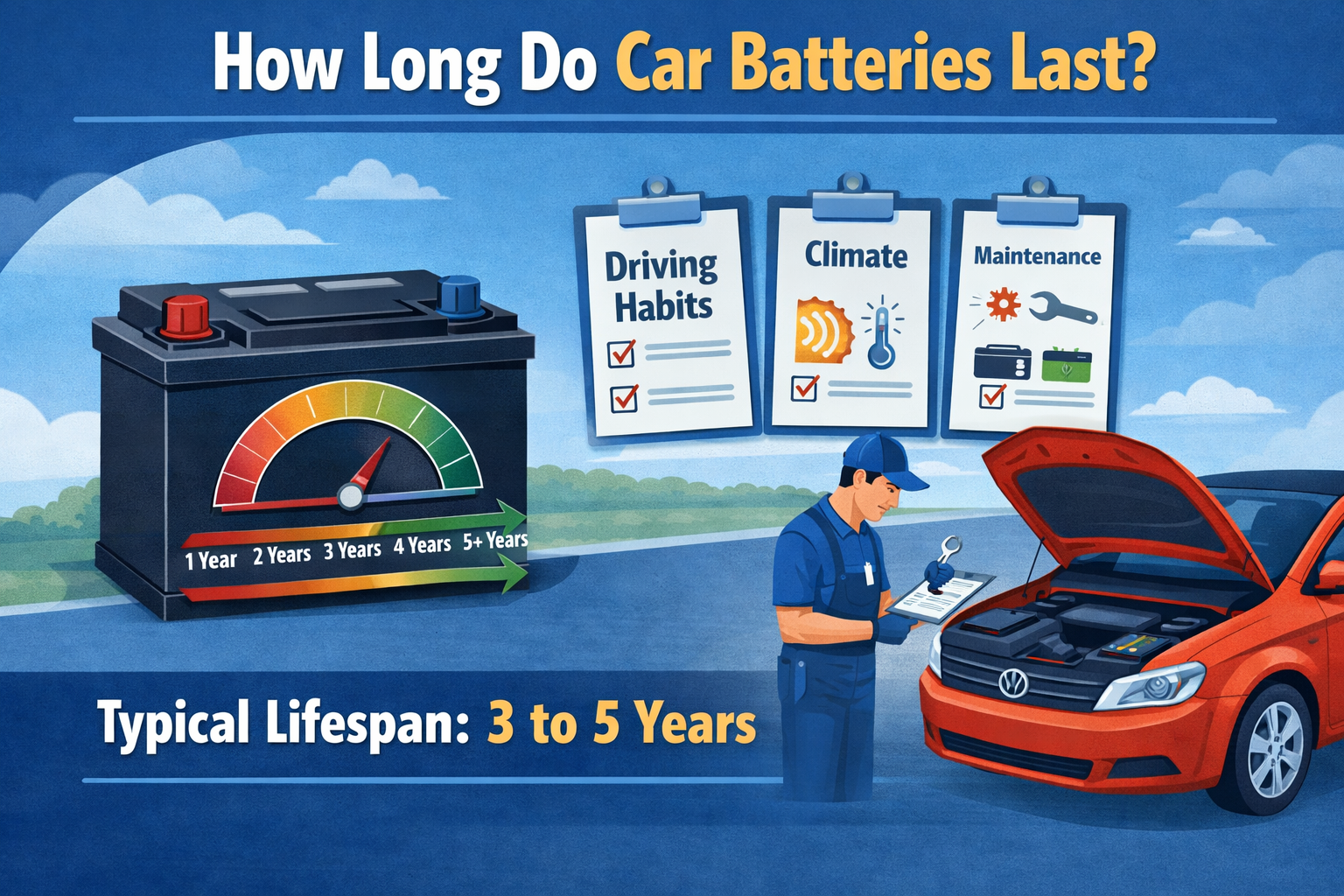
How Long Do Car Batteries Last? The Essential Guide to Lifespan & Signs of Failure
There is nothing quite like the sinking feeling of turning your car key and hearing a weak “click-click-click” instead of a roaring engine. It usually happens at the worst possible moment—when you’re late for work or stranded in a parking lot.
While most drivers treat car batteries as a “set it and forget it” component, they are the chemical heart of your vehicle. Understanding the lifespan of a battery is the only way to ensure you aren’t left stranded.
The Real Answer: The Average Car Battery Lifespan
In a perfect world, a high-quality car battery should last between 3 to 5 years. However, the “real world” is rarely perfect. Depending on your location and how you use your car, you might find yourself needing a replacement as early as year two, or stretching a premium battery to year six.
Think of your battery like a smartphone. Every time it drains and recharges, the internal lead plates degrade slightly. Eventually, the chemistry simply can’t hold a charge anymore.
The Silent Battery Killers: Why Lifespans Vary
If your neighbor’s battery lasted six years and yours died in three, it’s likely due to one of these three factors:
1. The “Short Trip” Syndrome
Your alternator (the car’s onboard generator) needs time to “refill” the battery after the massive energy surge required to start the engine. If you only drive 5–10 minutes at a time, your battery never fully recharges. Over time, this leads to acid stratification, permanently weakening the battery.
2. Temperature Extremes
It’s a myth that cold weather is the biggest battery killer. Heat is actually much worse. High under-hood temperatures evaporate the liquid electrolyte inside the battery and accelerate internal corrosion. Winter merely “finishes off” a battery that was already damaged during the summer.
3. Parasitic Drain
Modern cars are never truly “off.” Computers, security systems, and keyless entry sensors sip power 24/7. If you leave your car sitting for weeks without a trickle charger, these tiny draws will eventually deep-cycle the battery, which is often fatal for standard lead-acid units.
5 Red Flags That Your Battery is Failing
Your car will almost always try to warn you before the battery dies completely. Look for these “early warning” signs:
-
The Slow Crank: If the engine takes 3–5 seconds to start instead of firing up instantly, the battery’s “Cold Cranking Amps” (CCA) are dropping.
-
Dimming Electronics: Do your headlights look yellowish? Do the power windows move slower than usual? This indicates the battery is struggling to meet the car’s electrical load.
-
The “Rotten Egg” Smell: If you notice a pungent sulfur smell under the hood, your battery may be leaking or overcharging, creating a dangerous gas buildup.
-
Corroded Connectors: Look for white, ashy powder on the metal terminals. This buildup restricts the flow of electricity and is a sign of an aging unit.
-
The Battery Warning Light: If that little red rectangle stays illuminated on your dashboard, it’s time for a professional voltage test immediately.
How to Extend Your Battery Life
You can’t make a battery last forever, but you can certainly stop it from dying early:
-
Tighten the Hold-Down: Vibration is a major cause of internal plate damage. Ensure your battery is securely clamped in its tray.
-
Clean the Terminals: Use a mixture of baking soda and water to scrub away corrosion every six months.
-
Drive Longer: At least once a week, take your car for a 20-minute highway drive to allow the alternator to provide a full “deep charge.”
Frequently Asked Questions (FAQ)
Q: Can I jump-start a dead battery and keep using it?
A: A jump-start is a temporary fix. If your battery died because you left the lights on, it might recover. If it died “randomly,” the internal cells are likely damaged, and it will fail again soon.
Q: Does my car’s start-stop system wear out the battery?
A: Cars with auto start-stop use specialized AGM (Absorbent Glass Mat) batteries designed for frequent cycling. Replacing these with a standard battery will lead to failure within months.
Q: Is it okay to change my car battery myself?
A: For most older cars, yes. However, many modern luxury vehicles require “battery registration” via the car’s computer to tell the alternator how to charge the new unit. Check your owner’s manual first.
Q: How do I know if the problem is the battery or the alternator?
A: If you jump-start the car and the engine dies shortly after you remove the cables, the alternator likely isn’t providing power. If the car runs fine but won’t restart later, the battery is the culprit.
