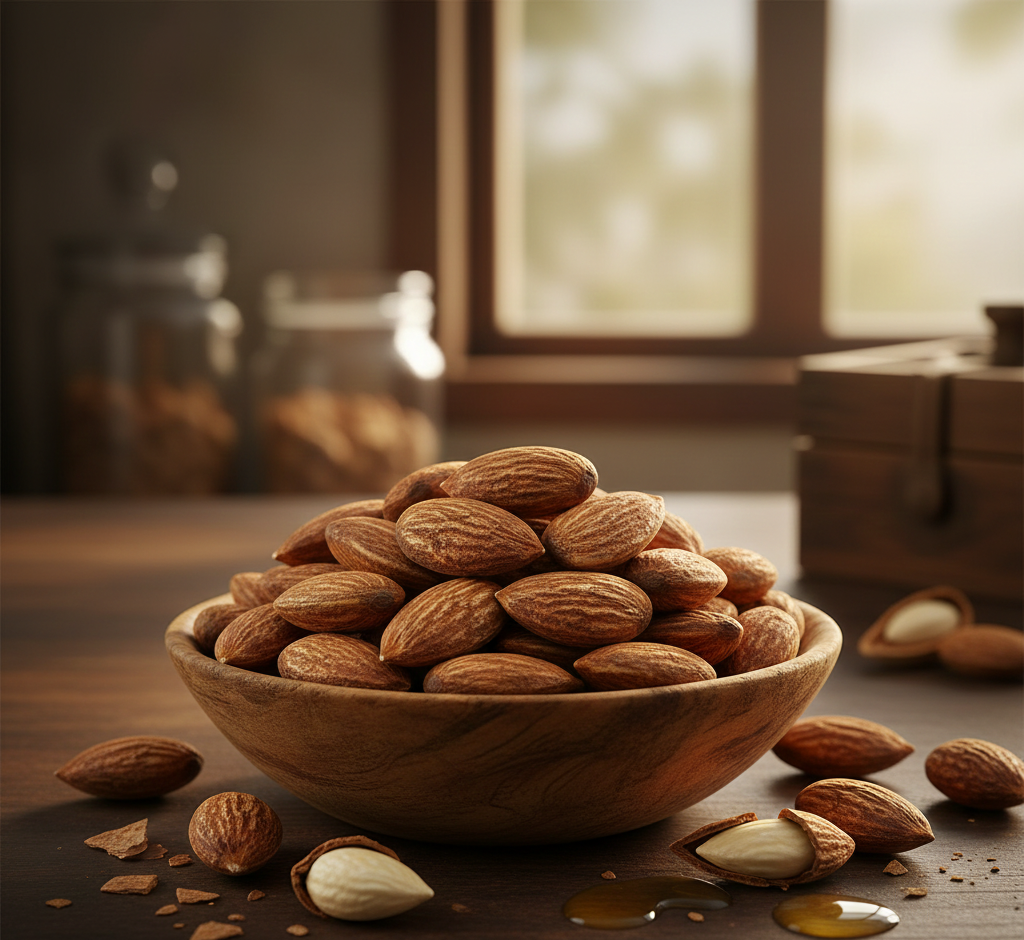
If you walk into a traditional dry fruit market in Old Delhi or Mumbai, you’ll notice that while most almonds look uniform, large, and polished, there is one variety that stands out by looking almost… “imperfect.” They are small, slightly concave or curved, and have a bit of a shriveled skin. These are Mamra almonds, and in the world of nutrition, they are considered the absolute gold standard.
While California almonds (the ones we see most commonly) are mass-produced and mechanically processed, Mamra almonds are a heritage crop. Grown primarily in the cold, rugged terrains of Afghanistan and Iran, and a small portion in Kashmir, these almonds are not just a snack—they are a potent traditional medicine.
In this guide, we’ll dive deep into what makes Mamra almonds so special, why their price tag is higher, and how they can solve real health problems in your daily life.
1. The Real Difference: Mamra vs. California Almonds

Most people are used to California almonds because they are affordable and look “pretty.” However, if you are eating almonds for health rather than just crunch, you need to know the difference.
-
Oil Content: This is the biggest factor. California almonds have their natural oils partially extracted during heavy mechanical processing. Mamra almonds are processed manually and retain 100% of their natural oils. If you press a Mamra almond between two papers, you’ll often see an oil stain—that’s the “brain gold” right there.
-
Cultivation: California almonds account for nearly 80% of the world’s supply and are grown with heavy irrigation and pesticides. Mamra is grown organically in caves and mountain slopes, relying on natural snowmelt and minimal human interference.
-
The “Bitter” Factor: Occasionally, you might find a bitter Mamra almond. While annoying, this is actually a sign of their organic, wild nature. California almonds are bred to be 100% sweet, losing some of their medicinal complexity in the process.
2. Solving Health Problems with Mamra Almonds
Because of their high monounsaturated fat and nutrient density, Mamra almonds are often prescribed by Ayurvedic and Unani practitioners for specific issues.
Problem: Poor Memory and Mental Fatigue
We often hear our elders say, “Eat soaked almonds for a sharp brain.” With Mamra, this isn’t just a myth. They are rich in Riboflavin (Vitamin B2) and L-carnitine, which are essential for brain development.
-
The Solution: For students or professionals under high stress, 5-7 soaked Mamra almonds every morning can significantly improve cognitive retention and focus.
Problem: High “Bad” Cholesterol (LDL)
Heart health is a major concern today. Mamra almonds are packed with Vitamin E and healthy fats that help scrub the arteries.
-
The Solution: Replacing processed evening snacks with a handful of Mamra almonds helps increase HDL (good cholesterol) while keeping LDL in check.
Problem: Weak Digestion and Low Energy
California almonds can sometimes feel “heavy” or cause bloating if not soaked properly.
-
The Solution: Mamra almonds are naturally lighter on the stomach. Because they contain more fiber and natural oils, they act as a mild lubricant for the digestive tract, aiding in smoother bowel movements.
3. Why Are Mamra Almonds So Expensive?
If you’ve checked the price of Mamra almonds lately, you know they can cost 3 to 4 times more than regular badam. Here is the honest breakdown of why:
-
Scarcity: They account for less than 4% of global almond production. You can’t just “grow more” Mamra; they require specific altitudes and climates found only in the Iran-Afghan belt.
-
Manual Labor: Every single Mamra almond is hand-picked, hand-shelled, and sorted. There are no massive factories involved, which keeps the quality high but the volume low.
-
Purity: You are paying for the absence of chemicals. These are as close to “wild” as a nut can get.
4. How to Identify Original Irani Mamra
Unfortunately, because they are expensive, there is a lot of “adulteration” in the market. Some sellers mix “Gurbandi” (which is also good but cheaper) with Mamra. Here’s how to tell:
-
The Shape: Mamra is never perfectly flat. It has a distinct “concave” (curved inward) shape, like a small boat or a comma.
-
The Skin: It should be slightly wrinkled and dark brown. If the almond looks too smooth or light-colored, it’s likely not an Irani Mamra.
-
The Taste: When you bite into it, it shouldn’t just be crunchy; it should feel “oily” or buttery on the tongue.
5. Storage Tips: Keeping the “Oil” Fresh
Since Mamra almonds have high oil content, they can turn “rancid” (smell like old oil) if not stored correctly.
-
Airtight is Key: Use a glass jar with a tight seal.
-
Cool and Dry: Avoid keeping them near the stove or in direct sunlight. In peak summer (especially in places like Delhi or Mumbai), it is actually better to store them in the middle shelf of your refrigerator to preserve the oils.
-
Don’t Mix: Never store fresh Mamra with salted or flavored nuts, as they will absorb the moisture and smell.
Frequently Asked Questions (FAQs)
Q1. Should I peel the skin of Mamra almonds? A: While the skin contains tannins that can inhibit nutrient absorption, it also contains fiber. The best way is to soak them overnight (8-10 hours). If you find the skin hard to digest, peel it. If not, eating them with the skin after soaking is perfectly fine.
Q2. How many Mamra almonds should a child eat? A: For children aged 5-12, 2 to 3 soaked almonds are sufficient. For adults, 5 to 8 is the recommended daily limit. Remember, they are calorie-dense!
Q3. Is it okay to eat them in summer? A: Yes, but always soak them. Soaking reduces the “internal heat” (taseer) of the nut, making it safe for consumption even in the hot Indian summers.
Q4. Can pregnant women eat Mamra almonds? A: Yes, they are an excellent source of folic acid and iron. However, always consult your doctor regarding the quantity, as every pregnancy is different.
Q5. Why do some Mamra almonds taste bitter? A: This is a natural occurrence in wild/semi-wild almond varieties. A small percentage (1-2%) of bitter almonds is normal. If the whole batch is bitter, that’s a quality issue, but 1 in 50 is just nature being nature.
The Bottom Line
Choosing Mamra almonds is an investment in your long-term health. Think of it this way: you can either spend a little more on high-quality nutrition now or spend much more on supplements and doctors later. For brain health, heart protection, and pure, chemical-free energy, there is simply no substitute for a genuine Irani or Afghani Mamra.

