For most Indian households, a meal isn’t complete without a bowl of steaming hot dal. Whether it’s the comfort of Dal-Chawal after a long day or the festive richness of Dal Makhani, pulses are the undisputed backbone of our diet.
But beyond the comfort factor, there’s a serious nutritional question often asked by fitness enthusiasts and vegetarians alike: Is dal actually enough for protein? If you look at the raw data, the numbers look great. But since we don’t eat raw lentils, understanding the “math” behind dal protein per 100g is key to making sure you aren’t falling into a protein deficit. Let’s break down the facts, the fixes, and the real numbers.
The Raw Truth: Dal Protein Numbers
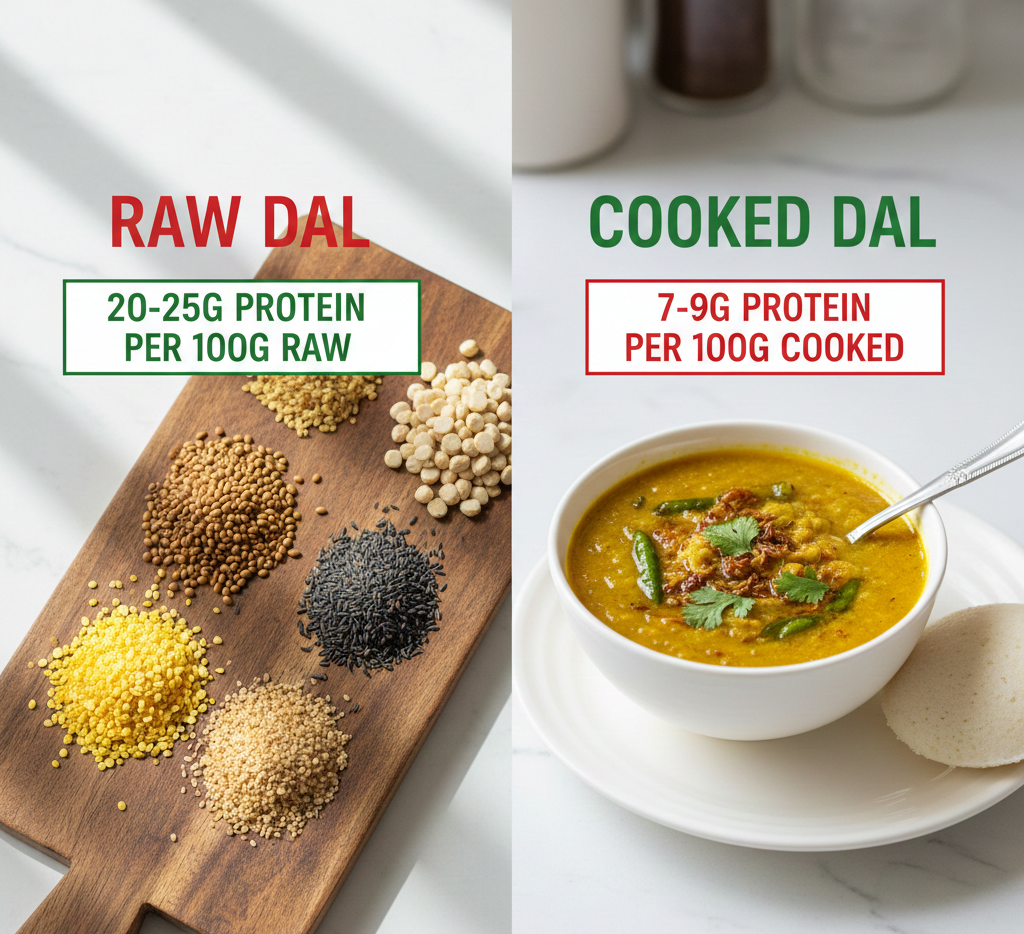
When you see a nutrition label or a chart, it usually refers to raw/dry dal. On average, most Indian dals offer between 21g to 25g of protein per 100g in their raw state.
Here is how the most popular dals stack up (values are approximate per 100g raw):
| Dal Type | Protein (Raw) | Top Benefit |
| Moong Dal (Yellow) | ~24g | Lightest on the stomach; best for recovery. |
| Masoor Dal (Red) | ~25g | High in Iron; cooks incredibly fast. |
| Urad Dal (Black) | ~25g | Highest in Calcium and fiber; great for strength. |
| Toor/Arhar Dal | ~22g | Rich in Folic Acid; the ultimate daily staple. |
| Chana Dal | ~20g | Low Glycemic Index; excellent for sugar control. |
The “Cooked” Reality Check
The biggest mistake people make is thinking they get 25g of protein from one bowl of dal.
When you cook 100g of raw dal, it absorbs water and expands to become roughly 300g to 400g of cooked dal (depending on how thick you like it). Therefore, the dal protein per 100g of cooked dal drops to about 7g to 9g.
-
1 Katori (Standard Bowl): Usually holds 150g–200g of cooked dal.
-
Protein per Bowl: Approximately 10g to 14g.
The Problem: If your daily requirement is 60g of protein and you only eat one thin bowl of dal, you’re barely hitting 15% of your goal. You need to be more strategic.
How to Fix the “Incomplete Protein” Problem
There is a common myth that plant protein is “low quality.” The truth is that most dals lack an essential amino acid called methionine, while grains (like rice and wheat) lack lysine.
The Solution: Our ancestors already solved this! When you eat Dal-Chawal or Dal-Roti, the amino acids from the grain and the pulse combine to form a complete protein profile, similar to eggs or meat.
Pro Tip: To maximize protein, keep your dal thick. A watery dal (patli dal) means you’re mostly drinking seasoned water with very few lentils—and very little protein.
5 Ways to Supercharge Your Dal Protein
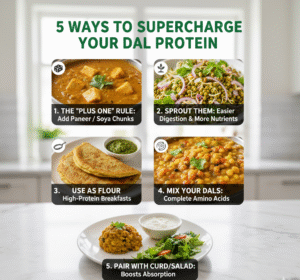
If you want to increase your intake without eating five bowls of dal, try these “hacks”:
-
The “Plus One” Rule: Add 50g of paneer cubes or a handful of soya chunks directly into your dal tadka. This can easily push your bowl from 10g of protein to 20g+.
-
Sprout Them: Sprouting moong or chana increases the bioavailability of nutrients and makes the protein easier to digest.
-
Use it as a Flour: Don’t just make curries. Use Moong dal or Besan (chana flour) to make Chillas for breakfast.
-
The Thick Tadka: Instead of just oil and cumin, use a tadka of crushed garlic, ginger, and even a little bit of curd or cream to add density and micronutrients.
-
Mix Your Dals: Mixing 3-4 types of dals (Panchratna dal) provides a wider variety of minerals like Magnesium, Zinc, and B-Vitamins along with the protein.
Frequently Asked Questions (FAQs)
Q: Which dal has the highest protein?
A: Urad Dal and Masoor Dal generally lead the pack with about 25g of protein per 100g (raw). However, the difference between most dals is minor; consistency and portion size matter more.
Q: Is it okay to eat dal every day?
A: Absolutely. In fact, the ICMR (Indian Council of Medical Research) recommends about 60g-90g of pulses daily for a balanced diet. It’s a great source of fiber which keeps your gut healthy.
Q: Does pressure cooking destroy the protein?
A: No. While extreme heat can slightly alter some vitamins, pressure cooking actually makes the protein more digestible by breaking down anti-nutrients like lectins and phytates that can interfere with mineral absorption.
Q: Can I build muscle just by eating dal?
A: Dal is a great base, but for significant muscle gain, you likely need a more concentrated source to meet higher protein targets without overeating calories/carbs. Pair dal with whey protein, eggs, or paneer to hit those higher numbers.
Summary Table for Quick Reference
| Serving Size | Approx. Protein |
| 100g Raw Dal | 22–25g |
| 100g Cooked Dal (Thick) | 8–9g |
| 1 Bowl (200g) Cooked Dal | 12–14g |
| 1 Plate Dal-Chawal | 15–18g |
Resources & References:
-
ICMR-NIN: Dietary Guidelines for Indians (2024)
-
IFCT (Indian Food Composition Tables) by National Institute of Nutrition


