
When you step into a high-energy wedding, a bustling outdoor concert, or a professional DJ gig, there is one piece of equipment doing the heavy lifting behind the scenes: the 15-inch speaker. Often referred to as the “workhorse” of the audio world, the 15-inch driver is the most popular choice for anyone needing a balance of portability, power, and deep frequency response.
In this guide, we’ll dive deep into why this specific size is the industry standard, how to troubleshoot common issues, and what you need to look for when choosing between different models, from 360W entry-level units to 1500W powerhouses.
Why the 15-Inch Speaker Rules the Market
In the world of audio engineering, size matters because of physics. A speaker produces sound by moving a cone back and forth to create pressure waves in the air.
-
Low-End Punch: While a 12-inch speaker is great for vocals, it often lacks the surface area to move enough air for deep bass. A 15-inch speaker has significantly more “cone real estate,” allowing it to reproduce frequencies as low as 40Hz to 50Hz with authority.
-
The All-in-One Solution: For many mobile DJs, carrying a separate subwoofer is a hassle. A high-quality 15-inch speaker (like the YX15X635) provides enough “thump” to act as a full-range solution, handling both the bass and the crisp highs in a single cabinet.
-
Efficiency: Because the 15-inch driver is larger, it doesn’t have to work as hard as a smaller speaker to achieve the same volume, which often leads to lower distortion at high decibel levels.
Understanding the “Ferrite” Advantage
If you’ve browsed professional catalogs, you’ll notice many speakers labeled as the Ferrite Series. Ferrite is the traditional ceramic magnet material used in the motor structure of the speaker.
While newer materials like Neodymium are lighter, Ferrite remains the king of professional audio for several reasons:
-
Thermal Stability: During a 6-hour event, your speakers get hot. Ferrite magnets handle high temperatures extremely well without losing their magnetic strength.
-
Cost-Effectiveness: You get more “watts per rupee.” Models like the 15PS400 offer professional-grade sound at a fraction of the cost of exotic magnet materials.
-
Durability: Ferrite magnets are rugged and less prone to “magnetic shift” if the speaker cabinet is bumped or dropped during transport.
High Wattage vs. Low Wattage: Which is for You?
One of the biggest mistakes beginners make is thinking “more watts equals better sound.” The wattage you choose should depend entirely on your venue and audience size.
Small Gatherings (50–100 People)
For small indoor parties or background music, a speaker in the 360W to 450W range (such as the HY1501) is perfect. These speakers are usually lighter and require less power from your amplifier, making them easy to set up.
Medium Events (100–300 People)
This is where the 500W to 800W speakers shine. Models like the ZX15X600 are designed for high-pressure environments. They feature larger voice coils (usually 3 or 4 inches) that can withstand the heat generated by playing heavy-bass music for hours on end.
Large Concerts and Professional Stages (500+ People)
If you are providing sound for a large festival or a high-end club, you need the heavy hitters. The 1000W P2226 or the 1500W YX15X451 II are designed to be “thrown” across long distances. These usually feature 4-layer voice coils and heavy-duty aluminum baskets to prevent the frame from warping under extreme stress.
Common 15-Inch Speaker Problems & How to Solve Them
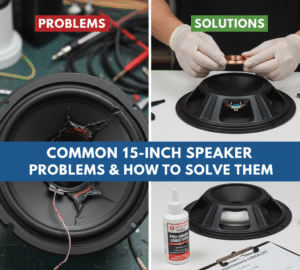
No matter how expensive your gear is, professional audio is a high-stress environment for electronics. Here are the most common issues reported by users and how to fix them.
1. The “Scratchy” Sound (Voice Coil Rub)
The Symptom: When you play music at low volume, you hear a raspy, scratchy noise. The Cause: Dust has entered the magnetic gap, or the speaker has been “over-excursed” (pushed too far), causing the voice coil to go out of alignment. The Solution: First, check if the noise is coming from your cable. If the speaker is truly damaged, it will need a re-coning kit. To prevent this, always keep your speaker grills clean and avoid playing music that causes the cone to “jump” uncontrollably.
2. Sudden Silence (Blown Fuse or Coil)
The Symptom: The speaker stops working entirely, but the amplifier is still on. The Cause: Often caused by “Clipping.” When your amplifier reaches its limit, it stops sending a clean wave and starts sending a “Square Wave.” This acts like a heater to your speaker’s voice coil, melting the wire. The Solution: You must replace the voice coil. To prevent this in the future, ensure your amplifier has about 20% more power than your speaker’s RMS rating, and never let the red “Clip” light stay on.
3. “Muddy” or Muffled Audio
The Cause: In a 2-way 15-inch cabinet, this usually means the HF Driver (Twitter) has blown, leaving only the 15-inch woofer to play. Since the woofer can’t play high notes, the music sounds like it’s coming from underwater. The Solution: Check your crossover network plate inside the cabinet. If the crossover is fine, you likely need a new diaphragm for your Compression Driver.
Maintenance: Protecting Your Investment
A professional 15-inch speaker can last 10–15 years if treated with respect. Follow these simple rules:
-
The “Warm-Up” Period: Don’t blast your speakers at full volume the second you turn them on in a cold room. Let them play at a low level for 10 minutes to allow the “surround” (the rubber or cloth edge of the cone) to become flexible.
-
Moisture Control: India’s monsoon season is tough on speakers. Paper cones can absorb moisture, making them heavy and prone to tearing. Use silica gel packets in your storage bags and never store speakers directly on a damp floor.
-
Secure Transport: Always transport your speakers with the cones facing each other or facing a flat surface. A stray pole or tool in the back of a truck can easily puncture a 15-inch paper cone.
FAQs: Everything You Wanted to Know
Q: Can I use a 15-inch speaker without a subwoofer? A: Yes! For most mobile DJ applications (weddings, birthdays), a high-quality 15-inch speaker provides enough bass. However, for electronic dance music (EDM) or heavy hip-hop in large halls, an 18-inch subwoofer is recommended to handle the sub-bass frequencies.
Q: What is a “4-Layer Voice Coil”? A: Found in high-end models like the HD Series, a 4-layer coil has more wire windings in the magnetic field. This gives the speaker more “motor force” and allows it to handle much higher wattage without burning out.
Q: Why does my speaker smell like it’s burning? A: This is a major warning sign! It means the glue on your voice coil is overheating. Turn the volume down immediately. If you continue, the coil will melt, and the speaker will fail.
Q: Does the “Cabinet” matter? A: Absolutely. A 15-inch speaker is only as good as the box it sits in. If the box is too small, the bass will be “tight” but weak. If it’s too large, the speaker might lose control and damage itself. Always use cabinets specifically tuned for 15-inch drivers.
Final Thoughts
The speaker 15 inch remains the cornerstone of the audio industry because it offers the perfect “middle ground.” It’s big enough to move the crowd but small enough to fit in a car. Whether you are looking for the clarity of the 15PHL76 or the raw power of the 15TBW100, understanding the technical side—magnets, wattage, and maintenance—will ensure your sound remains crisp and professional for every event.


