When we talk about tea, most people’s minds drift toward the mist-covered mountains of China or a refined afternoon spread in a London hotel. But India’s relationship with the tea leaf—the Camellia sinensis—is far more visceral, ancient, and wrapped in a legend that is as intense as it is spiritual.
To find the “Indian” origin of tea, we have to look past the 19th-century British plantations and travel back over a thousand years to a story involving a rebellious prince, a vow of silence, and a pair of eyelids.
The Man Behind the Myth: Bodhidharma
To understand the legend, you first have to meet its protagonist: Bodhidharma. In the annals of history, he is a titan. Born a prince in the Pallava Dynasty of South India (likely in modern-day Kanchipuram), he wasn’t interested in crowns or palaces. He was drawn to the teachings of the Buddha.
Bodhidharma eventually became a monk and traveled across the Himalayas to China, where he is now revered as the father of Zen Buddhism (called Chan in China) and the legendary founder of Shaolin Kung Fu. But it was during his legendary nine-year meditation session that the “discovery” of tea supposedly happened.
The Vow of the Nine-Year Stare
The story goes that Bodhidharma arrived at the Shaolin Monastery and sought a way to prove his devotion. He settled into a cave, facing a wall, and made a terrifyingly difficult vow: he would meditate for nine years straight without ever closing his eyes or succumbing to sleep.
For years, his iron will held firm. But as the story goes, toward the end of his journey, exhaustion finally caught up with him. In a momentary lapse of human frailty, his eyes flickered and he fell into a deep sleep.
The “Gory” Birth of the Tea Leaf
When Bodhidharma woke up, he wasn’t just tired; he was consumed by a sense of failure. He felt his own body—specifically his eyelids—had betrayed his spiritual quest. In a fit of extreme ascetic zeal, he took a knife, cut off his own eyelids, and threw them onto the ground so they could never betray him again.
The legend takes a supernatural turn here. From the blood-soaked earth where his eyelids fell, a strange new bush began to sprout. The leaves of this bush were shaped exactly like eyelids, fringed with tiny “lashes” (which we now know as the serrated edges of the tea leaf).
Curious, the monk plucked a few leaves and chewed them. Immediately, his mind cleared. The heaviness in his limbs vanished. He felt a sharp, calm alertness that allowed him to finish his nine years of meditation. This, according to Indian tradition, was the first tea plant—a gift to help seekers remain “awake” to the truth of the universe.
Moving from Legend to History: Was Tea Always in India?
While the story of Bodhidharma is a powerful religious myth, it points to a deeper historical truth: India didn’t need the British to “bring” them tea. The plant was already there, hidden in the jungles of the Northeast.
The “Wild” Discovery in Assam
For centuries, while the world thought tea was a Chinese secret, the Singpho and Khamti tribes of Upper Assam were already treating tea as a part of their daily life. They didn’t call it “tea” in the commercial sense; it was a medicine.
They would harvest wild leaves, dry them in bamboo stalks, and brew a smoky, dark infusion that they used to treat everything from stomach aches to fatigue. This native variety—Camellia sinensis var. assamica—is actually sturdier and more caffeinated than the Chinese variety.
The British “Interference”
The common narrative is that the British East India Company “founded” the Indian tea industry. In reality, they were just trying to break the Chinese monopoly on tea. They initially spent years trying to smuggle Chinese seeds into India, only to realize that a superior, native plant was already growing in their own backyard in Assam.
It wasn’t until a Scotsman named Robert Bruce was introduced to the native brew by a Singpho Chief in 1823 that the “commercial” history of Indian tea began. But the locals had been living the “legend” for generations.
Comparing the Legends: India vs. China
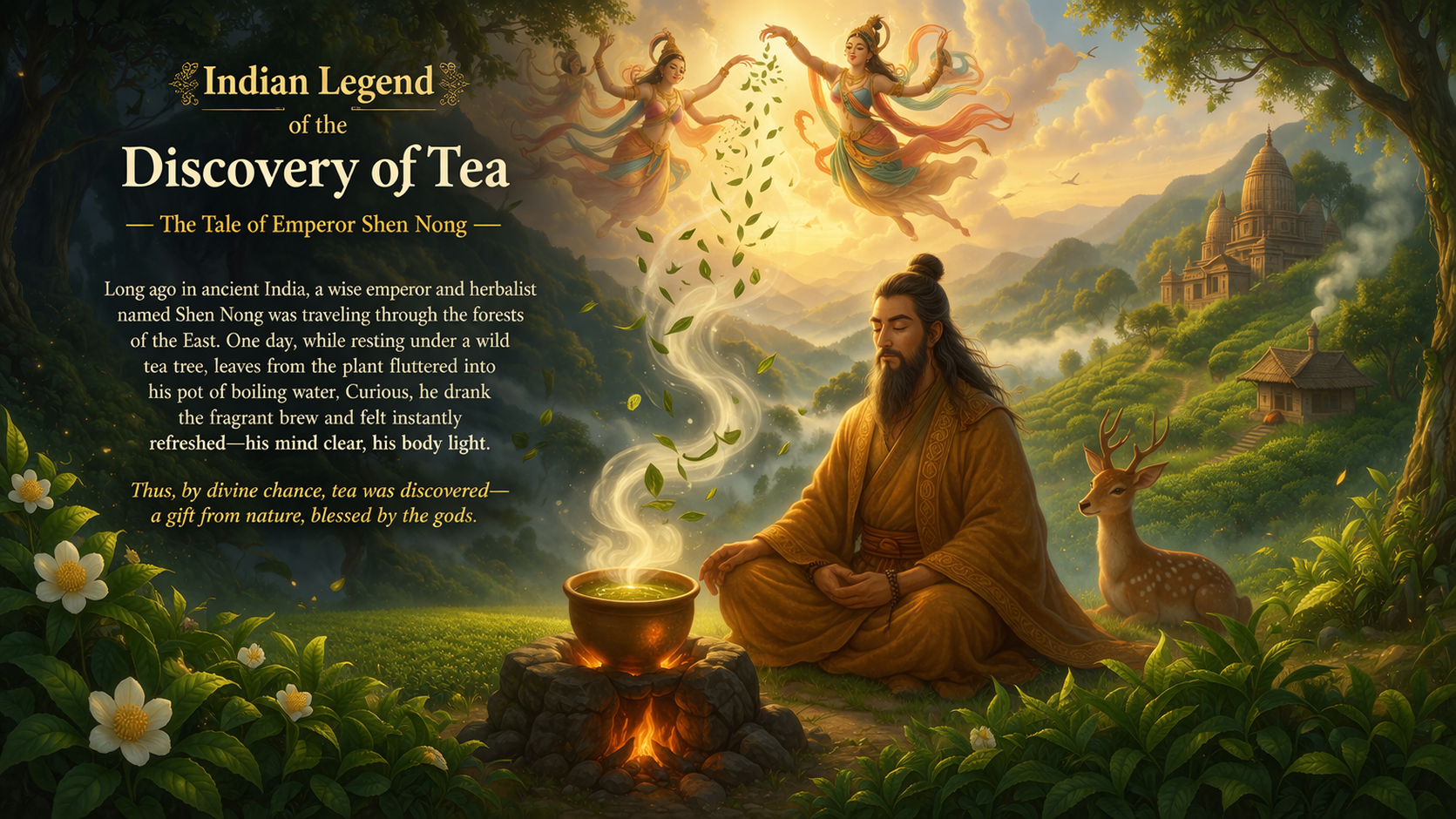
It’s worth noting that India isn’t the only country with a discovery myth. The Chinese have their own, featuring the Emperor Shen Nong in 2737 BCE.
| Feature | The Indian Legend | The Chinese Legend |
| Figure | Bodhidharma (A Monk) | Shen Nong (An Emperor) |
| The Moment | Pain and Sacrifice | A Happy Accident |
| The Result | Spiritual Wakefulness | Physical Detoxification |
| Theme | Conquering the Mind | Healing the Body |
The Indian legend is unique because it ties tea directly to the soul. It isn’t just a drink; it’s a tool for enlightenment. This explains why, even today, a cup of “Chai” in India is seen as a way to “wake up” your senses, not just quench your thirst.
The Evolution: From Monasteries to “Chai” Stalls
How did we get from a monk’s eyelids to the sugary, milky Masala Chai we see on every Indian street corner? It was a long, strange journey.
-
The Medicinal Era: For hundreds of years, tea in India was a “Kadha”—a medicinal decoction brewed with spices like ginger and black pepper to cure ailments.
-
The Colonial Push: In the early 20th century, the British needed to sell the massive amounts of tea they were growing in Assam and Darjeeling. They launched massive marketing campaigns at railway stations, encouraging Indians to take “tea breaks.”
-
The “Indianization”: Because high-quality tea was exported, the tea left for the local market was often “dust” or low-grade. To make it taste good, Indians added milk and sugar (which were plentiful) and spices (which were traditional). So, the modern Masala Chai was born. It is a mix of old Ayurvedic knowledge and colonial industry.
Why the Legend Is Still Important
Bodhidharma’s story reminds us that tea has a “spirit.” We now know that tea has a special mix of caffeine and L-theanine. Coffee gives you a “jolt” and a “crash,” but tea keeps you calm and focused for a long time.
The monks from long ago didn’t have lab equipment, but they knew exactly what this effect was. They knew that tea was the only thing that could keep them alert during the quiet of meditation. When we drink tea today, we are—albeit in a minor way—engaging in that same pursuit of clarity.
In short, the “Indian Flavour” of Tea
-
Spirituality: Tea is connected to the birth of Zen and the practice of Bodhidharma.
-
Indigenous Roots: The Assamica plant is a native of India, not an immigrant from China.
-
Cultural Identity: Tea has changed from the tribal “Phalap” to the modern “Chai,” and it is now the heart of Indian hospitality.
Last Thought
The story of the monk’s eyelids, whether it’s true or a beautiful metaphor, shows what tea means to India. It’s about the fight to stay awake, both physically and spiritually. It’s a drink that came from giving up something and is meant for those who are looking for it.
